
- Home
- Industries
- Multi-Entity Businesses
Accounting for multi-entity organizationsMore entities should not mean more versions of the truth.
ABFI coordinates recurring accounting across entities so bookkeeping, reconciliations, reporting, CPA handoffs, and advisory operate through one accountable structure.
- Entity A$218k cashClosed
- Entity B$94k cashClosed
- Entity C$61k cashReview
- Intercompany$18k open2 items
Every entity has its own books, and none of them agree.
Intercompany balances do not net to zero, shared costs are split by habit and the combined picture is rebuilt by hand.
Each entity can look “clean” while the group picture is unclear
Entity-level books are only useful if leadership can understand how the pieces relate.
Intercompany activity becomes a recurring reconciliation problem
Transfers and shared costs create noise when ownership is unclear or review is inconsistent.
Different entities close on different timelines
That makes consolidated leadership reporting slower and less dependable.
CPA coordination multiplies at year-end
More entities mean more schedules, more documentation, and more opportunities for missing context.
Entity Control Map
A multi-entity accounting function should preserve clean entity-level records while giving leadership one coordinated reporting and accountability layer.
ABFI’s job is to keep the accounting underneath reliable enough that a view like this can be trusted.
Each close should reconcile intercompany and give you one combined view.
- 01Are entity balances independently reconciled and review-ready?
- 02Are intercompany items identified and resolved consistently?
- 03Can leadership compare entities from the same close cadence?
- 04Can the CPA handoff happen without the owner assembling the packet?
- Entity booksEach entity reconciled on its ownReviewed
- IntercompanyBoth sides of every transfer match2 open
- Shared costsAllocated under a written methodMonthly
- Group viewIntercompany activity removedReady
Illustrative example
See what a Diagnostic finds in a multi-entity group.
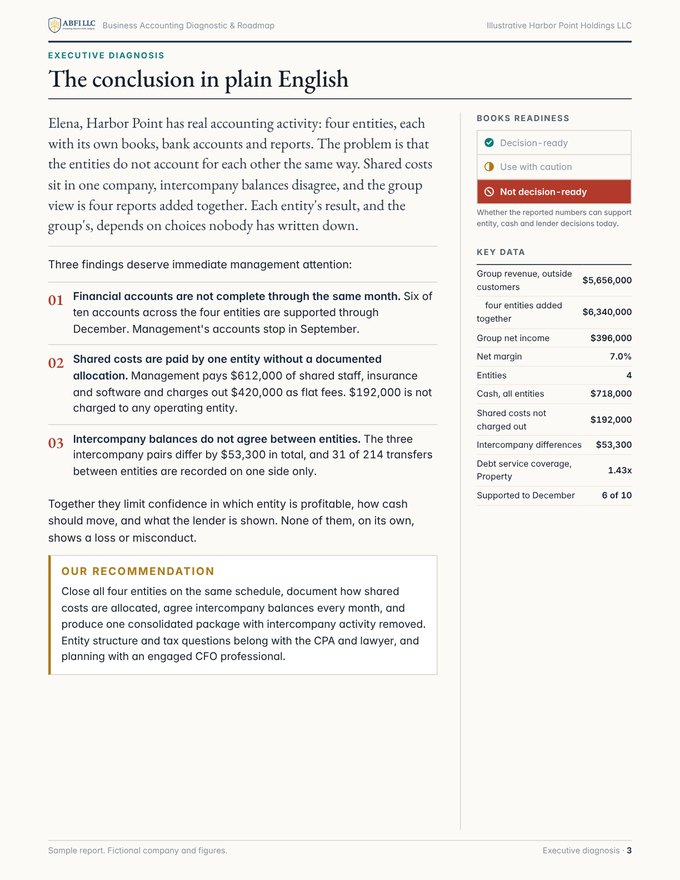
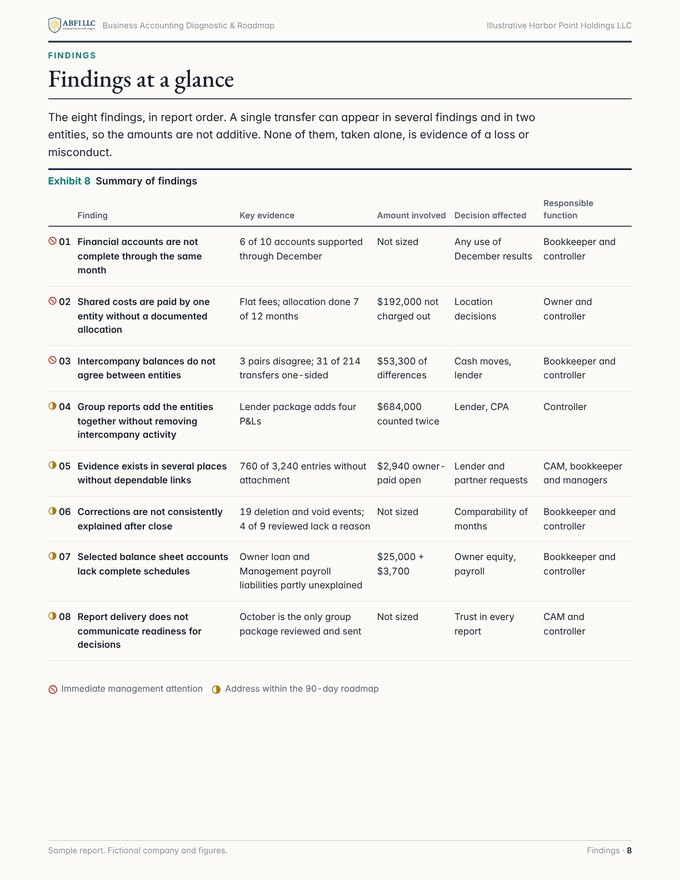
The central question in this sample: can the owner rely on the books to judge each entity on its own, see the group as one business, move cash between entities, and answer the lender? Three of the eight findings are specific to multi-entity groups.
- 02Shared costs are paid by one entity without a documented allocation$192,000 not charged out
- 03Intercompany balances do not agree between entities$53,300 of differences
- 04Group reports add the entities together without removing intercompany activity$684,000 counted twice
Fictional company and figures, built to show what an owner receives. Complimentary with a subscription to The ABFI Accounting Brief.
The work stays specialized. Accountability stays unified.
Each layer has a different job. ABFI coordinates the layers, with one point of accountability through Client Accounting Management, so the owner is not the integrator.
Bookkeeping
Disciplined transaction recording, reconciliations, document organization, and payroll alignment.
ValidationController Review
A review layer that owns the close, validates balances, and protects reporting integrity.
CoordinationCPA Coordination
Accurate records and organized documentation for independent CPAs engaged by the client.
DirectionCFO Advisory
Forecasting, cash planning, budgeting, and decision support grounded in reliable records.
Built for Multi-Entity Businesses
- Groups with multiple LLCs, operating companies, locations, or related entities that need disciplined entity-level accounting and coordinated oversight.
Probably not the fit
- Single-entity businesses with very simple books and no recurring oversight requirement.
Before you hand over the function.
A few questions leaders usually need answered first.
How is ABFI different from basic bookkeeping for multi-entity businesses?
Bookkeeping is only the first layer. ABFI also reviews and closes each month, reports on it, prepares the CPA handoff and advises on decisions, with one person answerable for all of it.
What is in the multi-entity sample Diagnostic report?
Eight findings on a fictional four-entity group, Illustrative Harbor Point Holdings LLC, including shared costs paid by one entity with no allocation, intercompany balances that disagree, and a lender package that counts intercompany activity twice. Each finding shows the evidence, the amount involved, the decision it affects and who fixes it, followed by a 90-day roadmap.
Does ABFI prepare tax returns?
No. ABFI does not provide tax preparation or CPA services. Independent CPAs are engaged directly by the client. ABFI supports tax readiness through accurate records, organized documentation, and coordination.
Can ABFI work with the systems we already use?
Usually, yes. We look at your current setup in the first conversation and keep what works. We only suggest a change when a tool is causing errors or extra work.
What if the books are already behind or unreliable?
ABFI provides clean-up and catch-up accounting where needed so ongoing accounting can begin from a reliable foundation.
Who owns communication?
ABFI uses a coordinated structure with a single point of accountability so the owner is not required to integrate multiple disconnected providers.
Get one reconciled picture across every entity, every month.
Bring the current setup. ABFI will help you determine where the gaps are, what should be owned, and whether a managed fractional accounting department is the right structure.
What clients say
“Finding him has been one of the biggest blessings for our business.”
Client of founder Jordan Wells
“He has completely transformed our bookkeeping and financial organization.”
Client of founder Jordan Wells
Start with one call
Talk with ABFI about your books. Bring your questions and your messiest account, and we'll tell you which plan fits.
Or call (804) 391-4002